

Artificial intelligence is transforming cybersecurity at a rapid pace. In previous years, AI was mainly used to strengthen defensive tools, helping organizations detect threats faster and automate responses. In 2026, the situation has changed. AI is now influencing both sides of the cybersecurity battlefield. Attackers are using AI to build more advanced threats, while enterprises are deploying AI agents, copilots, and generative AI systems across everyday business workflows.
This shift has created a new and rapidly growing category known as AI security. Unlike traditional cybersecurity tools, AI security platforms are designed to protect not only networks and endpoints but also AI models, prompts, agents, and automated decision systems.
Modern enterprises face three major AI-related security challenges:
- Securing how employees use generative AI tools and prompts
- Protecting AI models, agents, and infrastructure from misuse
- Defending against cyberattacks powered by artificial intelligence
Because of these risks, companies are investing in dedicated AI security solutions that combine traditional cybersecurity with new controls designed specifically for AI environments.
In this article, we compare five of the strongest enterprise AI security platforms in 2026, based on features, architecture, and use cases: Check Point, CrowdStrike, Cisco, Microsoft, and Okta.
Why AI Security Is Critical in 2026
AI has changed how cyberattacks are created and executed. Threat actors now use machine learning to automate reconnaissance, generate convincing phishing messages, and modify malware to avoid detection.
Some of the biggest risks introduced by AI include:
- AI-generated phishing emails that look realistic
- Automated malware mutation that bypasses signatures
- Prompt injection attacks targeting AI assistants
- Data leaks through generative AI tools
- Unauthorized actions by AI agents
At the same time, enterprises are embedding AI into core business processes. Employees use copilots to write code, summarize documents, and interact with data. AI agents can trigger workflows, make purchasing decisions, and interact with internal systems.
Because of this, the attack surface has expanded. Security teams must now protect not only users and devices but also AI interactions, model behavior, and automated systems.
AI security platforms are designed to handle this new complexity.
Check Point – AI Security the Entire Enterprise
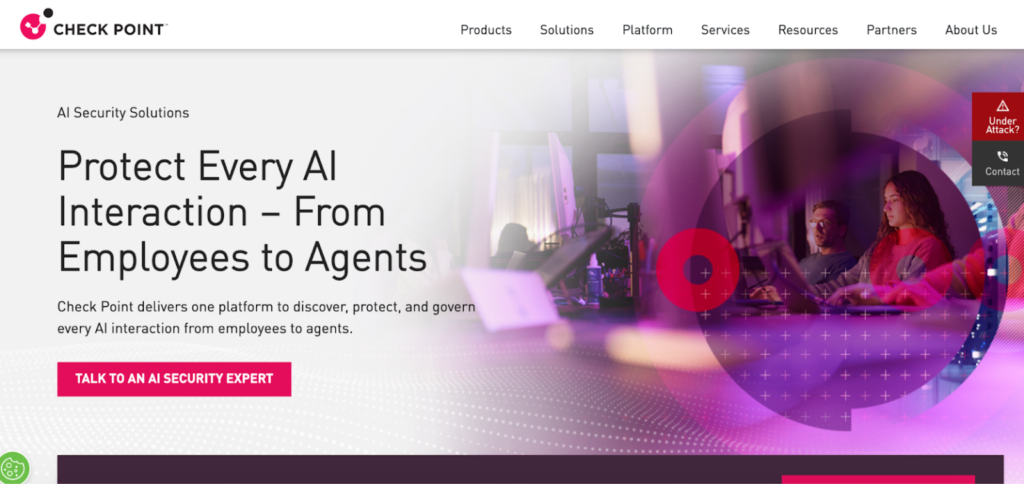
Check Point takes a platform-based approach to AI security by integrating protection into its Infinity architecture, which covers networks, cloud workloads, endpoints, and AI usage.
At the center of the system is ThreatCloud AI, a threat intelligence engine powered by more than 50 AI models and data collected from over 150,000 connected networks. When a threat is detected in one environment, indicators of compromise are shared across the platform in seconds.
This allows coordinated defense across multiple domains.
One of the most important features is GenAI Protect, which monitors how employees interact with generative AI tools. Instead of relying on simple keyword filters, the system uses semantic analysis to understand the meaning of prompts. This helps enforce data loss prevention policies in real time.
Check Point also secures AI infrastructure and improves security operations through Infinity AI Copilot, which assists analysts with investigations and response actions.
Independent testing has shown strong performance against zero-day malware, and the platform continues to rank highly in firewall and hybrid security evaluations.
Check Point is best suited for large enterprises that want a single platform covering infrastructure, AI usage, and security operations.
CrowdStrike – AI Security Built Into Endpoint and Cloud Telemetry
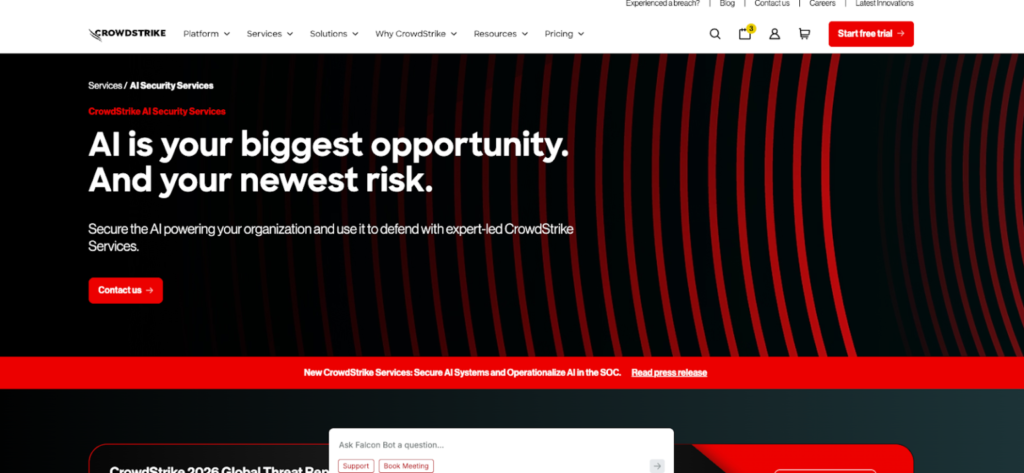
CrowdStrike extends its well-known Falcon platform to include AI protection. Instead of creating a separate product, the company integrates AI security into existing telemetry from endpoints, identities, and cloud workloads.
One of the key additions is Falcon AIDR, which focuses on defending against prompt injection and manipulation attacks targeting AI agents.
Prompt injection is a growing threat where attackers try to trick AI systems into revealing data or performing unauthorized actions. Falcon AIDR is designed to detect these attacks while maintaining low latency, which is essential for production AI systems.
CrowdStrike also uses AI to improve security operations. Charlotte AI acts as an assistant for analysts, allowing natural language queries, automated investigation, and faster incident triage.
Because the platform already collects large amounts of endpoint and cloud data, AI security features can be added without deploying new tools.
This makes CrowdStrike a strong choice for organizations already using the Falcon ecosystem.
It is especially effective for companies that rely heavily on endpoint and cloud telemetry for threat detection.
Cisco – Network-Level AI Defense and Traffic Visibility
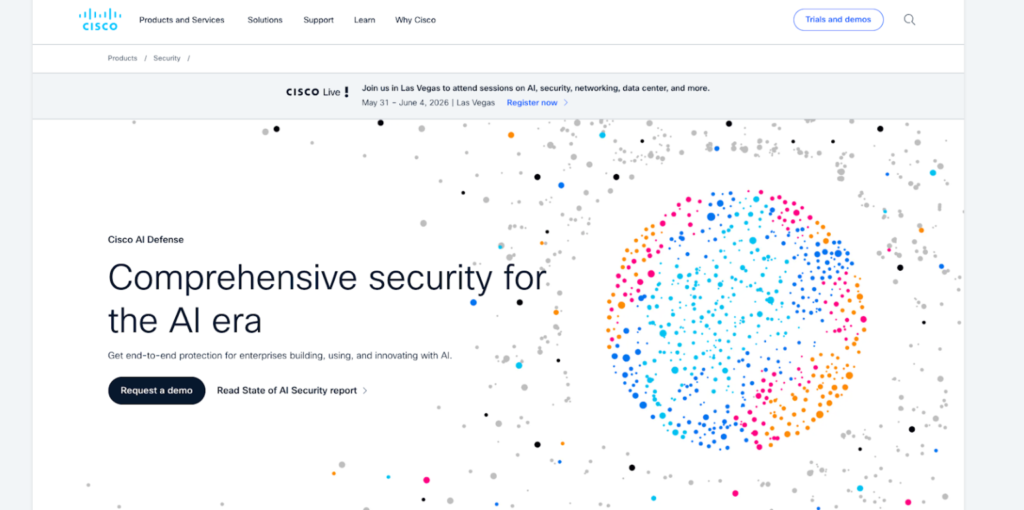
Cisco approaches AI security from a different angle. Instead of focusing on endpoints, it protects AI activity at the network layer.
Because Cisco infrastructure sits between users, applications, and cloud services, it can inspect traffic related to AI systems, including API calls, model requests, and agent communication.
The company’s AI Defense capabilities are integrated into its Security Service Edge (SSE) architecture.
Recent updates include several features designed specifically for AI environments:
- AI Bills of Materials to map dependencies inside AI systems
- Real-time guardrails for agentic workflows
- Red-team simulations to test AI security
- Monitoring of model interactions and API traffic
Cisco also aligns its controls with industry frameworks such as the NIST AI Risk Management Framework and MITRE ATLAS, which makes the platform attractive for organizations that must meet strict compliance requirements.
Because many large enterprises already use Cisco networking equipment, adding AI security at the traffic level can be easier than deploying new endpoint tools.
Cisco is best suited for companies with strong network infrastructure that want visibility into AI activity across the entire environment.
Microsoft – AI-Enhanced Security at Global Scale

Microsoft’s advantage in AI security comes from scale. The company processes tens of trillions of security signals every day across its global cloud and enterprise ecosystem.
Its AI security capabilities are built into tools that many organizations already use, including:
- Defender
- Entra
- Intune
- Purview
At the center is Security Copilot, an AI assistant that helps analysts investigate alerts, understand threats, and automate response actions.
Security Copilot can:
- Summarize incidents
- Suggest remediation steps
- Generate reports
- Perform natural language searches across logs
Microsoft has also expanded AI security posture management to cover multi-cloud environments. This means organizations can monitor AI workloads running on AWS, Google Cloud, or other platforms, not just Azure.
For companies already using Microsoft 365 enterprise licenses, AI security features can often be added without deploying additional vendors.
This reduces complexity and makes Microsoft a strong choice for organizations deeply integrated into the Microsoft ecosystem.
Okta – Identity-First Security for AI Agents
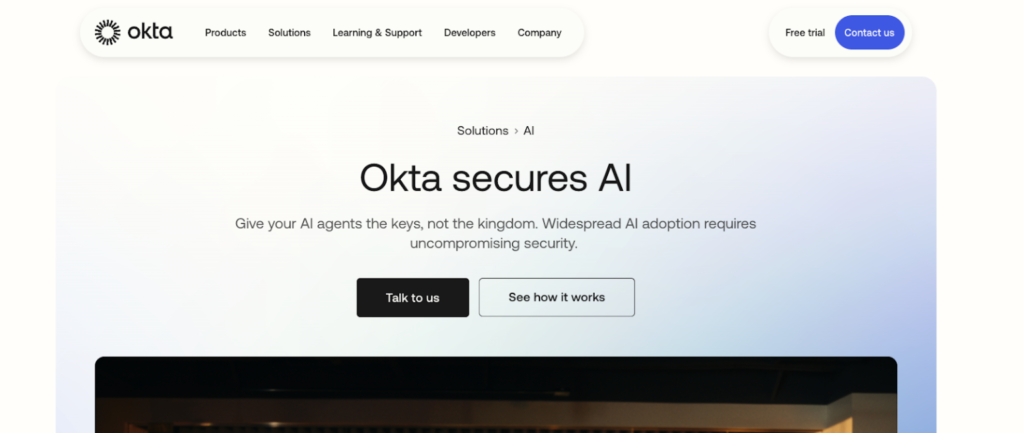
As AI agents become more common, identity security becomes one of the most important areas to protect.
Many AI systems operate with high privileges, allowing them to access data, trigger workflows, or make decisions automatically.
Okta focuses on this challenge by treating AI agents as identities, just like human users.
Its platform applies authentication, authorization, and lifecycle management controls to both human and non-human actors.
Key capabilities include:
- Identity Security Posture Management
- Detection of over-privileged accounts
- Real-time risk monitoring
- Governance for non-human identities
- Extended OAuth support for AI connections
This approach is important because traditional security tools often do not track AI agents properly.
As organizations deploy more autonomous systems, identity-centric security becomes essential.
Okta is best suited for companies that are deploying AI agents at scale and need strong governance over who or what can access systems.
Comparison of Top AI Security Platforms in 2026
| Vendor | Core Strength | Best For |
|---|---|---|
| Check Point | Unified AI security across infrastructure and usage | Large enterprises wanting one platform |
| CrowdStrike | Endpoint and cloud telemetry with AI protection | Falcon-focused environments |
| Cisco | Network-layer visibility and AI traffic monitoring | Cisco-centric infrastructure |
| Microsoft | Massive signal intelligence and Copilot automation | Microsoft 365 enterprises |
| Okta | Identity governance for AI agents | Organizations with many AI identities |
Each platform focuses on a different entry point into AI security.
Choosing the right one depends on architecture, existing tools, and security priorities.
How to Choose the Right AI Security Solution
There is no single best AI security platform for every organization.
Companies should consider their current environment and risk level before selecting a solution.
Organizations building their own AI models should prioritize infrastructure protection.
Companies worried about employee use of generative AI should look for prompt monitoring and data loss prevention.
Security teams struggling with alert volume may benefit from AI-powered SOC automation.
Businesses deploying many AI agents should focus on identity governance.
AI security is not separate from traditional cybersecurity. It overlaps with:
- Network security
- Identity management
- Cloud protection
- Compliance
- Incident response
The best solution is the one that fits naturally into the existing ecosystem.
AI Is Both a Tool and a Target
In 2026, artificial intelligence is not only helping defend against cyberattacks, it is also being used to create them.
This means organizations must protect their AI systems just as carefully as their networks and devices.
Enterprises that treat AI security as part of their overall architecture will be better prepared for new threats.
Platforms like Check Point, CrowdStrike, Cisco, Microsoft, and Okta show that the industry is moving toward integrated protection rather than isolated tools.
As AI adoption grows, security strategies must evolve with it.
Companies that invest in AI security today will be in a stronger position to manage the risks of tomorrow.